website

This is an archive of our retired blog. Please visit out current website

www.berlindrawingroom.com

Contemporary Botanical Artists


Linda Stillman uses actual plants as pigment to create her colorful drawings and paintings, often plants from a specific garden or location. The identification of the plants becomes a part of the title and the artwork itself.

'August' Garden scroll by Linda Stillman

Taryn Simon:
In Paperwork and the Will of Capital, Simon examines accords, treaties, and decrees drafted to influence systems of governance and economics, from nuclear armament to oil deals and diamond trading. All involve the countries present at the 1944 United Nations Monetary and Financial Conference in Bretton Woods, New Hampshire, which addressed the globalization of economics after World War II, leading to the establishment of the International Monetary Fund (IMF) and the World Bank. In images of the signings of these documents, powerful men flank floral centerpieces designed to underscore the importance of the parties present. Simon’s photographs of the recreated centerpieces from these signings, together with their stories, underscore how the stagecraft of political and economic power is created, performed, marketed, and maintained.
Each of Simon’s recreations of these floral arrangements represents an “impossible bouquet”—a concept that emerged in Dutch still-life painting parallel to the country’s seventeenth-century economic boom, which ushered in the development of modern capitalism. Then, the impossible bouquet was an artificial fantasy of flowers that could never bloom naturally in the same season and geographic location. Now the fantasy is made possible—both in the original signings and in Simon’s photographs—by the global consumer market.
For the recreations, Simon worked with a botanist and from archival records to identify all the flowers. She imported more than 4000 specimens from the world’s largest flower auction in Aalsmeer, Netherlands, where 20 million flowers arrive and depart daily, bound for international retail destinations. She remade the floral arrangements from each signing, then photographed them against striking bicolored fields relating to the foregrounds and backgrounds in the historical images, pairing each arrangement with a description of the pertinent accord. For the sculptures, selected specimens from the 36 arrangements were dried, pressed, and sewn to archival herbarium paper; a complete set of the 36 botanical collages was then placed in each of the 12 concrete presses, along with the same number of photographs and narrative texts—sealed together in a race against time.
- from the press release for Paperwork and the Will of Capital, at Gagosian in NY


Jenny Yurshansky:
Title: 
Blacklisted: A Planted Allegory (Herbarium)
Description: 
This herbarium was made by studying the California Invasive Species Advisory Council’s living list of invasive plant species.  The Claremont Colleges and their affiliated institutions were the site of this collection. Pitzer College Art Galleries invited me to be an Artist-in-Residence during Summer 2014. During that period I hunted for, located, identified, and collected the invasive plants that I found growing on the site. Out of CISAC’s 600 listed alien-invasive plants, I found 133 which are now indexed in this collection; a group that is simultaneously highly local and totally foreign. The original pressings of the plants have been recreated as hand-cut silhouette portraits. These cutouts function as caricatures of each plant’s identifying characteristics. Along with each silhouette, is a description of the plant's Latin and vernacular names, their arrival date in California and their place of origin. It is no accident that the dates of arrival reflect the eras of manifest destiny, periods of increasingly multi-ethnic immigration and global shipping trade; humans are the primary introduction vectors. Many of these plants are now thought to be culturally Californian because of their common place in cuisine, flower beds, kitchen gardens, and the overwhelmingly human shaped landscape.


Watercolor Technique: drawing vs painting approach


Edward Lear, "Abu Simbel", 1867
Watercolor is a versatile medium which is extremely responsive to a personal touch. Each brushstroke is visible through transparent layers and it is also possible to incorporate drawing into the finished painting. Over the course of the Watercolor Workshop, the goal is for each student to develop their own individual approach. We looked at a broad range of watercolor artists, with a focus on landscape painting, to get ideas for different approaches. In order to focus the discussion, we attempted to put each artists into one of two categories: artists with a Drawing Approach and artists with a Painterly Approach.

How would one go about defining these two approaches? That is of course up for discussion, but here are some of the characteristics we looked out for.

Drawing Approach:
- The painting started with a drawing, parts of which may still be visible.
- The foundation of the painting is tonal, meaning if you were to see it in black and white the image would be clearly defined.

Painterly Approach:
- The painting started with brushstrokes, no drawing is visible.
- The foundation of the painting is color and definition comes through color relationships, such as complimentary colors.

Edward Lear 
Edward Lear
Edward Lear
Paul Cezanne
Paul Cezanne
John Singer Sargent
John Singer Sargent
Emil Nolde
Emil Nolde
Arthur Dove
Arthur Dove
 Georgia O'Keeffe 
David Hockney
David Hockney 
David Hockney 
David Hockney


Botanical Drawing Exhibition: July 2-3

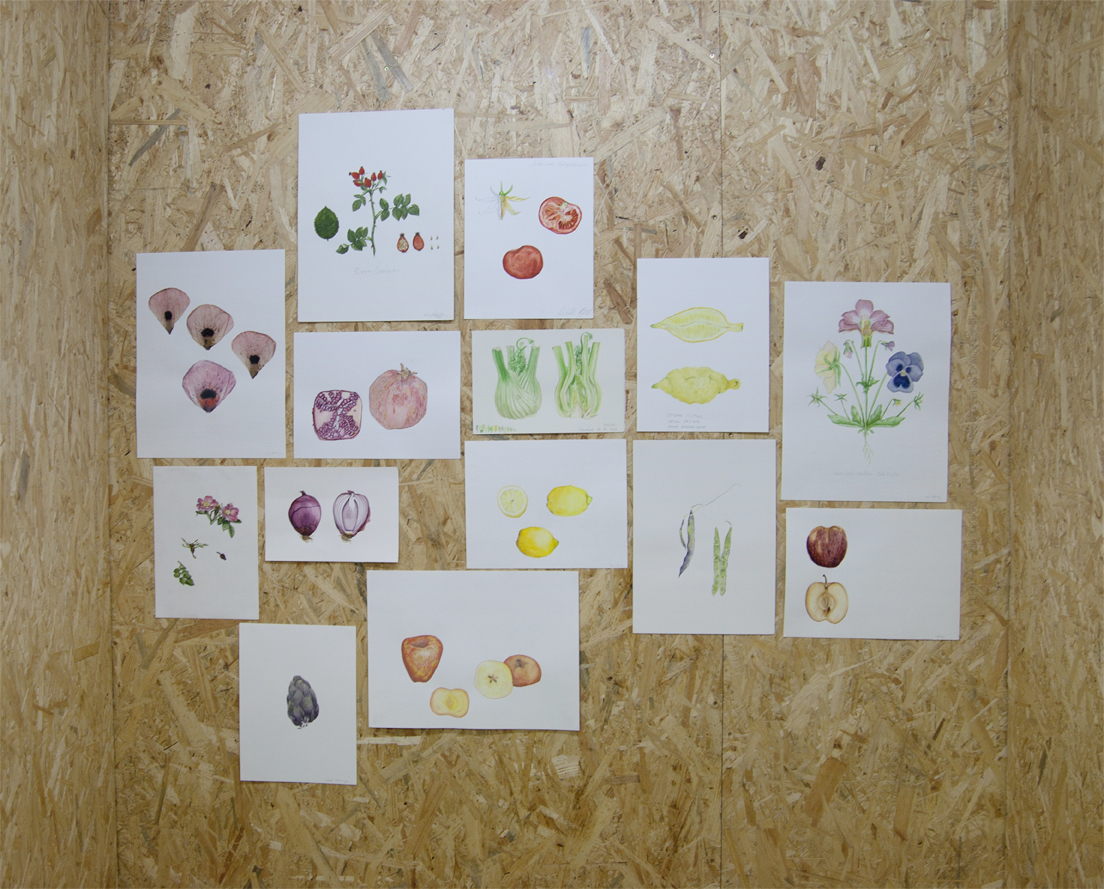
Please join us for a special exhibition of botanical illustrations created during the Botanical Drawing Workshop. The drawings and paintings on display were created through a process of close observation, both at the Prinzessinensgarten and the Berlin Drawing Room. 

The workshop is inspired by the Naturalists of the 19th century, who were simultaneously artists, explorers and scientists. Through the process of drawing from life, we are seeking to discover what kind of understanding and knowledge can be gained through direct observation. Does it have a different content or quality than knowledge acquired through more passive or indirect channels? Does the process of close observation, even when directed at mundane subject matter such as the weeds of Kreuzberg, yield something unexpected?

Botanical Drawing Exhibition: July 2-3
Opening Reception with the artists: July 2, 2-5 pm
Open for viewing Sunday: 12-5 pm

Location: Prinzessinnengarten
Tiny Haus (the small wooden house in the workshop area)
Prinzenstr. 35 – 38 / Prinzessinnenstr. 15 (U8 Moritzplatz), 10969 Berlin

More about the Botanical Drawing Workshop: http://www.berlindrawingroom.com/botanical/
Next Workshop dates: August 10-31
Thank you for everyone who participated in this exhibition, and the you everyone who visited!


Thanks for visiting!


Portrait Drawing Tips

Here are some of the diagrams we looked at in the Drawing Workshop. Although there are hundreds of anatomical drawings showing different splicings of facial proportions, these are the few basic ones I find the most useful.

I would also like to recommend Betty Edwards' "Drawing on the Right Side of the Brain," where I sourced a couple of the diagrams below. 

Of course the best thing is to rely on your observations, but these diagrams should help you get started with portrait drawing.


5 Useful Tips for Drawing Accurate Portraits

1) The most important ratio to remember is that the eyes are in the middle of the head. There is a tendency to want to put the eyes towards the top of the head, but this is incorrect. 
Facial Proportions for portrait drawing 
2) For a 3/4 view of the face, the central axis of the face is a curved line. You can imagine this as similar to longitudinal and latitudinal lines on a globe.
Structure for starting a 3/4 view portrait
3) The most common error in portrait drawing is making the skull too small. See the very helpful diagram below.
Cut-off Skull Error
source: Drawing on the Right side of the Brain by Betty Edwards
4) Sometimes it can be difficult to place the ear, when drawing a profile. It just seem to float out there on its own. Here is a measurement that will put the ear in its proper place. 

source: Drawing on the Right side of the Brain by Betty Edwards
5) Use the sighting technique for measuring angles with your pencil to measure the angle from the nice to the chin and from the nose to the forehead. There will be a substantial angle. Not a straight line.

Use sighting technique to measure the angle from nose to chin.