website

This is an archive of our retired blog. Please visit out current website

www.berlindrawingroom.com

Showing posts with label botanical illustration. Show all posts

Microscopy Botanical Drawing


During the last class of the Winter Botanical Drawing Workshop, we conducted an experiment in microscopy drawing. We had various levels of magnification available, from a jewelers glass to a lab microscope. 

As winter melted into spring, we had our first flowers at the Berlin Drawing Room garden, the reliable Crocus. These made for a great specimen and we were all to examine the petals, pollen, and structure of the stamen-stigma-style in the center of the flower. We resorted to the epidermis of an onion for highest level of magnification, x400, so that we could get a single cell layer for the slide. 
preparing slides, focusing microscope 

we used a webcam to produce a live feed of the microscope image showing the cell structure of an onion epidermis 
sometimes a jewelers glass is just enough magnification to get closer to a subject

experimenting with different levels of magnification to draw Crocus
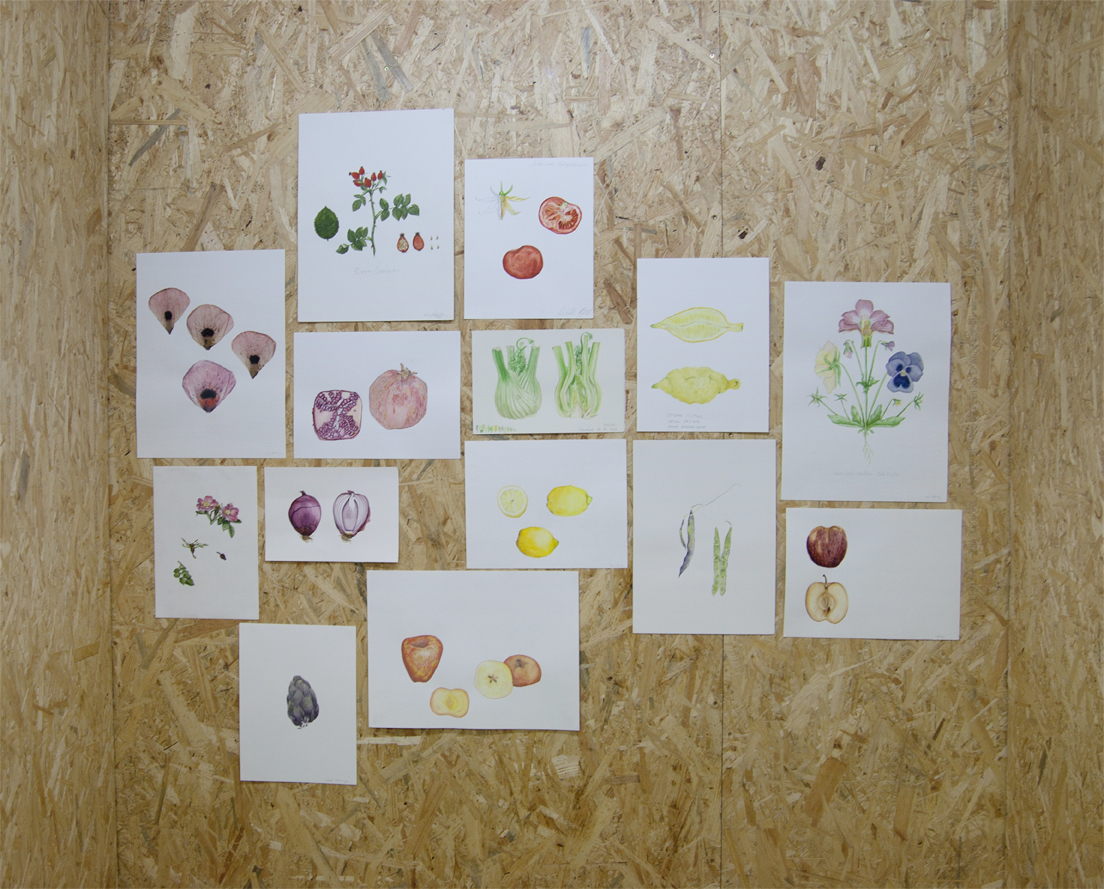
Here are some of the paintings produced from this experiment!


Cyanotype Botanical Illustrations by Anna Atkins

In the Botanical Drawing Workshop, we mainly focused on drawing and watercolor painting as methods for capturing the likeness of a plant. We did also experiment with pressing and drying plants to create Herbarium plates. While researching Cyanotype for another upcoming workshop at the Berlin Drawing Room, I was excited to learn that one of the earliest uses for this photographic technique was actually for botanical illustrations of seaweed by artist and scientist Anna Atkins.

This from the Public Domain Review, where you can also see more of her work:
"Anna Atkins (1799-1871) was an English botanist and the very first female photographer, most noted for using photography in her books on various plants. Having grown up with her father John George Children — a chemist, mineralogist, and not too successful zoologist — she was surrounded by science and also contributed to her father’s work. Her engravings of shells can be found in her father’s translated edition of Jean-Baptiste de Monet Lamarck’s Genera of Shells, published in 1823, but it is her work with cyanotypes that she is best known for. Through her father and her husband, Atkins came to know both William Henry Fox Talbot, a pioneer of early photography who invented a process of creating photographs on paper treated with salt and a solution of silver nitrate, and Sir John Herschel, the inventor of the cyanotype printing method. She became interested in the cyanotype process which produced images through so-called sun-printing. The object is placed on paper which has been treated with ferric ammonium citrate and potassium ferricyanide, after which it is exposed to sunlight and then washed in water, leading to the uncovered areas of the paper turning a dark blue. The process, known as blueprinting, was later used to reproduce architectural and engineering drawings, but Atkins chose to use it for what is considered to be the first work with photographic illustrations, namely her Photographs of British Algae: Cyanotype Impressions (1843). Only 13 copies of the handwritten book are known to exist, some of which are in various stages of completion. Later, she would collaborate with another female botanist, Anne Dixon (1799–1864), in making two more books featuring cyanotypes: Cyanotypes of British and Foreign Ferns(1853) and Cyanotypes of British and Foreign Flowering Plants and Ferns (1854). Atkins became a member of the Botanical Society in London in 1839, one of the few scientific societies which was open to women."


Botanical Drawing Exhibition: September 3-4

Please join us for a special exhibition of botanical illustrations created during the Botanical Drawing Workshop. The drawings and paintings on display were created through a process of close observation, both at the Prinzessinensgarten and the Berlin Drawing Room. 
The workshop is inspired by the Naturalists of the 19th century, who were simultaneously artists, explorers and scientists. Through the process of drawing from life, we are seeking to discover what kind of understanding and knowledge can be gained through direct observation. Does it have a different content or quality than knowledge acquired through more passive or indirect channels? Does the process of close observation, even when directed at mundane subject matter such as the weeds of Kreuzberg, yield something unexpected? 

Botanical Drawing Exhibition: September 3-4
Opening Reception with the artists: September 3, 2-5 pm
Open for viewing Sunday: 12-5 pm
Location: Prinzessinnengarten (Tiny Haus near the woodworking area)
Prinzenstr. 35 – 38 /  Prinzessinnenstr. 15 (U8 Moritzplatz), 10969 Berlin


Botanical Drawing Exhibition: July 2-3

Please join us for a special exhibition of botanical illustrations created during the Botanical Drawing Workshop. The drawings and paintings on display were created through a process of close observation, both at the Prinzessinensgarten and the Berlin Drawing Room. 

The workshop is inspired by the Naturalists of the 19th century, who were simultaneously artists, explorers and scientists. Through the process of drawing from life, we are seeking to discover what kind of understanding and knowledge can be gained through direct observation. Does it have a different content or quality than knowledge acquired through more passive or indirect channels? Does the process of close observation, even when directed at mundane subject matter such as the weeds of Kreuzberg, yield something unexpected?

Botanical Drawing Exhibition: July 2-3
Opening Reception with the artists: July 2, 2-5 pm
Open for viewing Sunday: 12-5 pm

Location: Prinzessinnengarten
Tiny Haus (the small wooden house in the workshop area)
Prinzenstr. 35 – 38 / Prinzessinnenstr. 15 (U8 Moritzplatz), 10969 Berlin

More about the Botanical Drawing Workshop: http://www.berlindrawingroom.com/botanical/
Next Workshop dates: August 10-31
Thank you for everyone who participated in this exhibition, and the you everyone who visited!


Thanks for visiting!


Botanical Cross-sections


Here are some examples of Botanical Cross-section illustrations to get some inspiration for Wednesday's class. 

Please bring a fruit, vegetable, or even a robust flower specimen to class on Wednesday. We will cut it open and make cross-section illustrations, so think about what looks interesting not only from the outside but also from the inside. Some suggestions would be: lemons, oranges, pomegranates, kiwis, bell-peppers, lilies, fennel, etc... Or see the examples below for ideas. 

Specimens are most interesting when you can have as many parts of the plant as possible. Sometimes if you go to a farmer's market or Biomarkt you can find a fruit with a few leaves attached. Or even better, take something from your own garden!

 Here are a few historical examples:

Georg Dionysius Ehret (1708-1770)
William Hooker (1779 – 1832)
Pierre Jean François Turpin (1775 – 1840)


 Examples of Botanical Cross-sections from the Botanical Drawing Workshop: